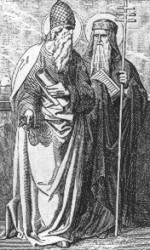
 St. Soter
Name: St. Soter
Date: 22 April
and SAINT CAIUS
Pope, Martyr
Saint Soter was raised to the papacy upon the death of Saint Anicetus in 161. By the sweetnessof his discourses he comforted all afflicted persons with the tenderness of a father, and assistedthe indigent with liberal alms, especially those who suffered for the Faith. He liberally extendedhis charities, according to the custom of his predecessors, to remote churches. He aided inparticular that of Corinth, to which he addressed an excellent letter. Saint Dionysius of Corinth inhis letter of thanks to Saint Soter, adds that the Pontifical letter together with the letter of SaintClement, Pope, was read for the edification of the faithful on Sundays, during their assemblies tocelebrate the divine mysteries. One of Saint Soter’s ordinances required all Christians except those in public penance to receiveCommunion on Holy Thursday. Saint Soter vigorously opposed the heresy of Montanus, andgoverned the Church up to the year 170. He was martyred on April 22, 170, under the emperorMarcus Aurelius, and buried on the Appian Way in the cemetery of Callixtus.
Pope Saint Caius, born in Dalmatia, was a relative of the emperor Diocletian. The cruel emperordid not for that reason spare him or his family during the bloody persecution of the years 283 to296, during which the Christians of Rome were obliged to conceal themselves in caverns andcemeteries. Saint Caius counseled a patrician named Chromatius to receive the tracked disciples of Christ inhis country residence. He himself went to visit them on a Sunday, and said to the faithfulassembled there that Our Lord Jesus Christ, knowing the fragility of human nature, establishedtwo degrees in the practice of Christianity, confession and martyrdom. Our Saviour did so, hesaid, “so that those who do not believe they could stand up under torment, may nonethelessconserve the grace of the faith by their confession.” Our Lord had indeed specified, “When youare persecuted in one city, flee to another...” Then he said, “Those who wish to stay in the houseof Chromatius, remain with Tiburtius, while those who prefer to return with me to the city,come.” Several followed him back to Rome; among them are the martyrs of the samepersecution, the brothers Saints Marcus and Marcellinus, and Saint Sebastian. Saint Caius himself received the crown of martyrdom in the final year of the persecution, 296, andwas buried in the cemetery of Callixtus, where his body was found in 1622, with an inscriptionidentifying him as Vicar of Christ. |




